Custom software development
Applications built to match a specific operational process rather than forcing the process to fit generic tooling.

Information technology services
We design, develop and support custom applications, web platforms and cloud infrastructure. Our engagements are structured around clear requirements, reviewable increments and documentation that outlives any single team member.
Company introduction
TABLE OF THE ELEMENTS LTD works with organisations that depend on software for daily operations. Much of our work involves systems that already exist: internal tools, customer portals, reporting pipelines and integrations that were built quickly and now need structure.
We start by describing the current situation accurately — what the system does, where it breaks, who depends on it — before proposing changes. That description becomes the shared reference for scope, estimates and acceptance criteria, so decisions are traceable rather than improvised.
The service descriptions on this website are draft material prepared for company review. They describe our intended approach rather than certified capabilities or guaranteed outcomes.

Core service areas
Seven connected areas cover the lifecycle of a business application, from the first requirements conversation to routine maintenance years later.
Applications built to match a specific operational process rather than forcing the process to fit generic tooling.
Browser-based systems with server-rendered content, structured state handling and predictable performance on modest connections.
Interface work grounded in the tasks people actually perform, expressed as flows, wireframes and a reusable component inventory.
Environment setup, deployment pipelines, monitoring and cost-aware sizing for hosted workloads.
Connecting applications, third-party APIs and internal data stores so manual re-entry and spreadsheet hand-offs can be retired.
Automated and exploratory testing, release verification and a defined route for defect reports after launch.
Software development
Development work is organised into small, reviewable changes. Each change carries a description of intent, a test that demonstrates the behaviour, and notes on anything a future maintainer would find surprising.
We name entities and states the way the business names them. When the code vocabulary matches the operational vocabulary, requirement discussions stop needing translation and defects become easier to describe precisely.
Schemas are designed for the queries the application actually runs, with explicit constraints, migration scripts kept in version control, and a documented plan for backfilling existing records.
We favour boring, well-supported technologies, keep dependency counts low, and write down the reasoning behind structural decisions so the next engineer inherits context rather than guesswork.
Web applications
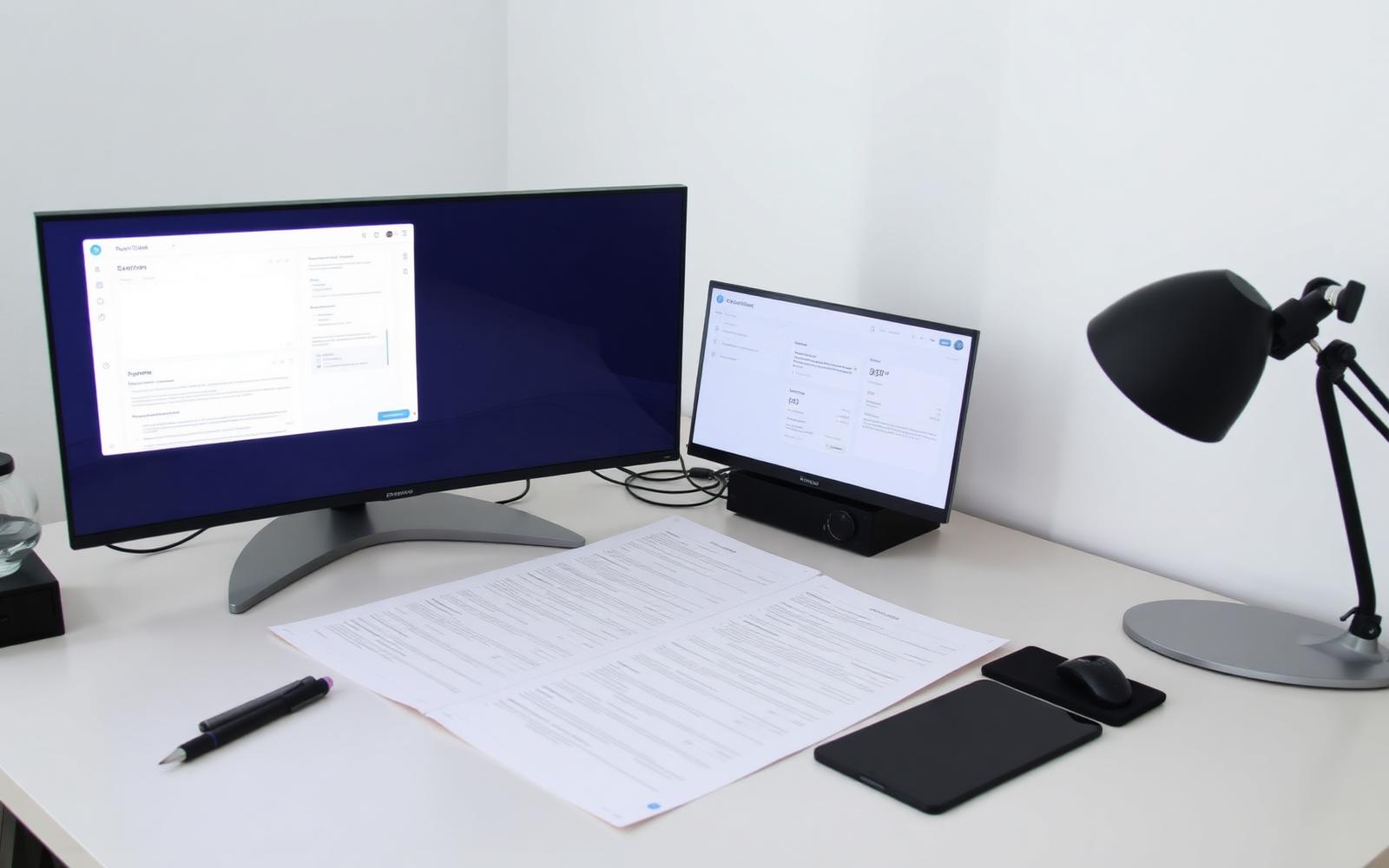
Most of the systems we build are used for hours at a time by people who know their job well. Speed, keyboard efficiency and predictable behaviour matter more than novelty.
Cloud and infrastructure
Infrastructure work aims for reproducibility. Configuration lives alongside application code, environments are described in files rather than in someone's memory, and deployments follow the same path every time.
Build, test and release steps run automatically, with a documented rollback path for each service.
Health checks, error reporting and resource metrics, tuned so that an alert means someone genuinely needs to act.
Scheduled backups paired with restore rehearsals, because an untested backup is only an assumption.
Resource sizing reviewed against real usage, with unused capacity reported rather than left running quietly.

Integration and automation
Workflow problems are often integration problems: two systems hold overlapping data and a person keeps them aligned by hand. We map those flows, then replace the manual step with a monitored, reversible process.
Documenting where each field originates, who edits it and which system is authoritative when values disagree.
Building and consuming interfaces with versioning, explicit error semantics and contract documentation.
Background jobs with retry policies, idempotent handlers and visible run history for auditing.
Failed records are queued and reported rather than silently dropped, so recovery is a routine task.
Experience and interface design
We begin interface work by writing down the tasks the product must support and the conditions under which they happen — time pressure, small screens, unfamiliar users, incomplete data.
Step one
A list of jobs the interface must support, ordered by frequency and consequence of error.
Step two
Low-fidelity screens that settle structure, navigation and empty, loading and error states before visual styling begins.
Step three
Shared tokens for colour, type and spacing, implemented once so screens stay consistent as the product expands.

Security-conscious practices
We do not present ourselves as a specialist security assessor. What we do is apply established engineering precautions throughout development rather than treating them as a final checklist.
Delivery process
Each phase produces something reviewable. If a phase does not justify the next one, that is a legitimate outcome and we say so.
01
Interviews, system walkthroughs and a written summary of goals, constraints and known risks.
02
Scope broken into deliverables with acceptance criteria, sequencing and an estimate range.
03
Short iterations ending in a working increment on a shared environment for review.
04
Deployment rehearsal, data migration checks, verification against acceptance criteria.
05
Defined channels for defects and change requests, plus scheduled maintenance windows.
Quality assurance
Test effort is directed at the paths that carry the most operational weight. Coverage percentages are a diagnostic, not a target.
Fast checks around calculations, validation rules and state transitions, run on every change.
Exercising real database access, queue handling and third-party contracts against controlled fixtures.
Automated walkthroughs of the handful of journeys that must never break.
Manual sessions aimed at awkward inputs, interrupted flows and unusual permissions combinations.
Defects are recorded with reproduction steps, expected behaviour and observed behaviour. Where a defect reached production, we note what would have caught it earlier and adjust the test suite accordingly.
Collaboration
Predictable communication reduces the need for status chasing. We agree the rhythm at the start of an engagement and keep to it.
Written first. Decisions, trade-offs and open questions are written down where the whole team can read them, so context survives holidays and hand-overs.
Regular demonstrations. Progress is shown in a running environment rather than described in percentages.
Early bad news. When an estimate slips or an approach turns out to be wrong, we raise it while options still exist.
Hand-over by default. Repositories, environment documentation and runbooks belong to the client throughout, not only at the end.

Frequently asked questions
A discovery phase. We review the existing system or requirement set and produce a written summary of goals, constraints and risks before any development scope is agreed.
Yes. Inherited codebases are a normal part of our work. We start with a read-only assessment covering structure, dependencies, tests and deployment before proposing changes.
Ownership terms are agreed in writing at the start of an engagement. Our default position is that clients hold their repositories, environments and documentation throughout.
Estimates are given as ranges tied to a defined scope, and revised openly when scope changes. We do not present an estimate as a guarantee.
Support arrangements are defined before release: how defects are reported, what response expectations apply, and how routine maintenance such as dependency updates is scheduled.
No. They are draft descriptions of a proposed service offering, pending company review. They describe intended practice and make no claim of certification, partnership or guaranteed result.
Contact information
TABLE OF THE ELEMENTS LTD
Email: [email protected]
Website: tableelementsco.com
Contact details are shown as plain text. This website does not operate contact forms, chat widgets or automated enquiry handling.